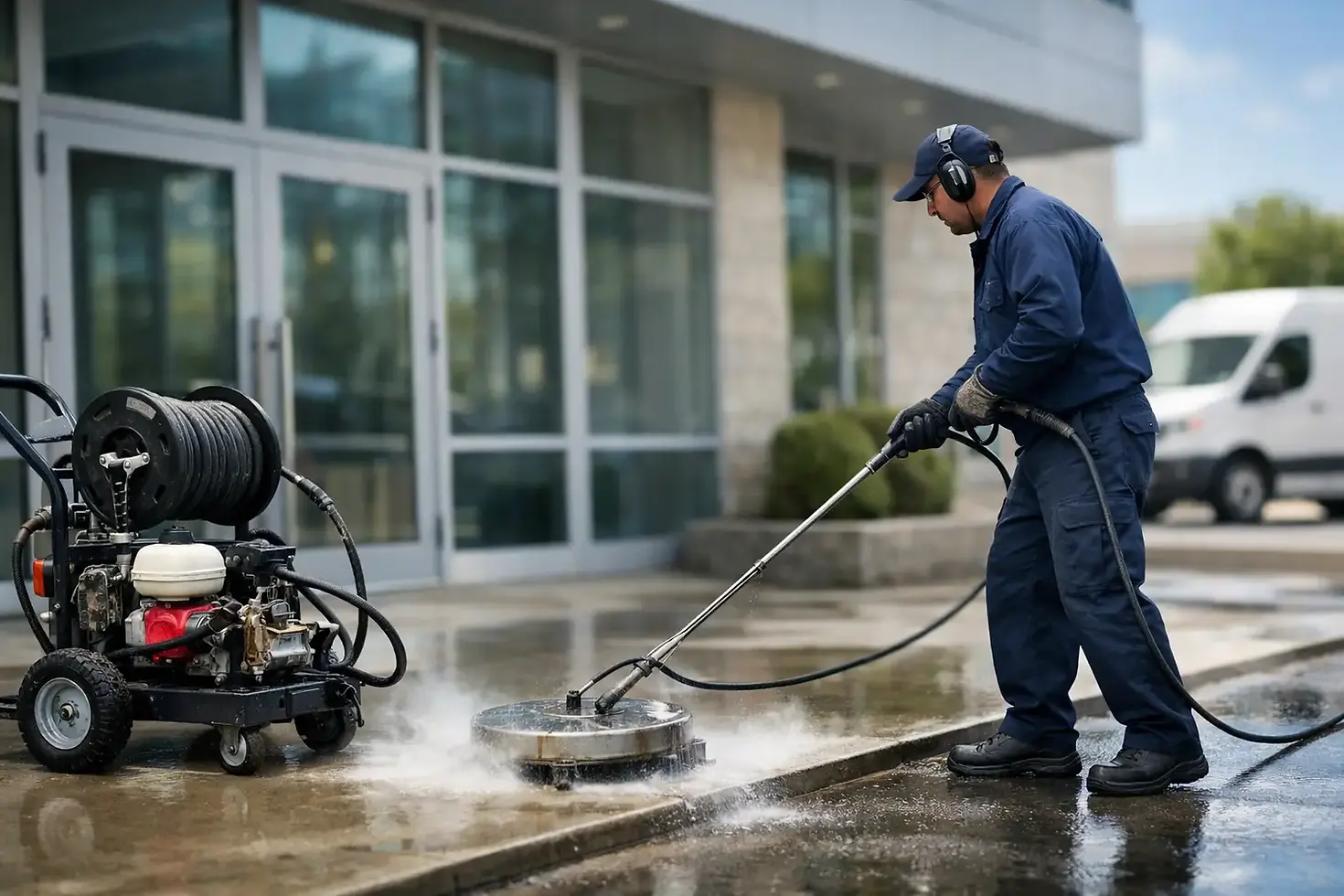
Commercial Pressure Washing Services Explained
- Sean Bolton
- May 8
- 6 min read

A stained entrance, slippery walkway or grime-covered forecourt says more about a business than most owners would like. Commercial pressure washing services are not just about making a site look cleaner. They help businesses keep outdoor areas safer, more presentable and easier to maintain, especially where customers, staff or deliveries move through every day.
For shops, offices, small industrial units, schools, hospitality sites and managed properties, the outside of the building often takes the worst of the weather. Moss builds up on paving, algae spreads across shaded areas, chewing gum marks entrances, and traffic grime settles into concrete and tarmac. Left too long, those surfaces stop looking professional and can become a genuine slip risk.
What commercial pressure washing services actually cover
Commercial pressure washing services are used to clean exterior hard surfaces around business premises. That can include entrances, paths, loading areas, courtyards, car parks, bin stores, external walls and paved areas where dirt, organic growth and surface staining build up over time.
The key point is that proper commercial cleaning is not simply about blasting everything with high pressure. Different materials need different treatment. Concrete can usually take a stronger clean than softer stone. Block paving may need a method that clears out grime without causing unnecessary disturbance. Painted or more delicate surfaces need a much more controlled approach.
That is where experience matters. A professional contractor looks at the surface, the type of contamination and the practical use of the area before deciding how to clean it. The aim is to improve the result while reducing the risk of damage, mess or disruption.
Why businesses book commercial pressure washing services
Most commercial customers get in touch for one of three reasons. The first is appearance. If customers arrive at a property with dirty paving, blackened walls or algae across the entrance, it affects the overall impression before they even step inside.
The second is safety. Slippery surfaces are a common issue around external walkways, especially in shaded areas or places that stay damp. Moss and algae can build up gradually, so the surface does not always look dangerous until somebody nearly slips on it.
The third is general upkeep. Exterior dirt is easier to deal with when it is managed properly rather than left to build into a heavier problem. Regular maintenance helps properties stay in better condition and often makes future cleaning more straightforward.
For many small and medium-sized businesses, that combination is what matters most - a cleaner site, a safer surface and a better standard of presentation without unnecessary hassle.
The surfaces that need the right approach
Not all exterior cleaning jobs are equal. One of the biggest mistakes in this type of work is treating every surface the same. A business premises may have a mix of block paving by the entrance, concrete service areas, natural stone paths and tarmac parking spaces. Each one responds differently to pressure, water flow and cleaning method.
Block paving often traps dirt, weeds and organic growth in joints and low spots. Concrete tends to hold tyre marks, general grime and weather staining. Natural stone can look excellent after cleaning, but it needs care because some types are more porous or prone to surface damage. Tarmac also needs a sensible approach, as too much force can affect the surface finish.
This is why surface-specific cleaning matters. It protects the material while still delivering a visible improvement. Businesses do not want a quick clean that leaves etching, striping or unnecessary wear behind.
High pressure is not always the best solution
People often assume pressure washing means using the highest setting possible. In practice, that is not how good results are achieved. Pressure is just one part of the process. Water volume, nozzle choice, surface condition and operator control all make a difference.
For some commercial areas, a lower-pressure wash with the right technique gives a better finish than aggressive cleaning. It depends on the material, the level of soiling and what the area is used for. That measured approach is usually what separates a professional result from a rushed one.
What a professional service should give you
A commercial customer is usually looking for reliability as much as cleaning power. The work needs to be carried out properly, with sensible planning and attention to the site itself. That means turning up when agreed, assessing access, working in a tidy manner and using methods suited to the property rather than applying a one-size-fits-all approach.
Fully insured work also matters. If you are responsible for a business premises, you need peace of mind that the contractor understands the environment they are working in and carries out the job professionally.
Clear communication is another part of a good service. Business owners and site managers want to know what is being cleaned, what result is realistic and whether there are any limitations based on staining, age or surface condition. Honest advice is more useful than overpromising.
When commercial pressure washing makes the biggest difference
Some sites need attention because they have become visibly dirty. Others benefit from cleaning before things reach that stage. Customer-facing premises usually see the biggest benefit where first impressions matter, such as shopfronts, entrances, forecourts and pedestrian routes.
Shared access areas also tend to show wear quickly. Foot traffic, weather exposure and regular use all leave a mark. Even if the building itself is well maintained, dirty exterior surfaces can drag down the overall appearance.
There is also a practical side. Moss, algae and built-up grime do not just affect looks. They can make routine maintenance more difficult and create recurring issues in damp or shaded spots. Cleaning those areas properly helps restore the surface and makes it easier to keep on top of going forward.
Timing depends on the site
There is no single schedule that suits every business. A busy entrance in a high-footfall area may need more regular attention than a private yard with lighter use. A shaded path under trees will usually build up moss faster than an open concrete space that gets full sun.
That is why the best approach is based on the property itself. The material, surrounding environment, footfall and weather exposure all affect how quickly surfaces deteriorate. Commercial cleaning is most effective when it responds to those real conditions rather than sticking to a fixed pattern for every site.
Choosing a contractor for commercial pressure washing services
If you are comparing providers, look beyond whether they offer pressure washing at all. The more useful question is whether they understand exterior surfaces and know how to clean them without causing avoidable damage.
A dependable contractor should be able to explain how they approach different materials, what sort of result you can expect and how they work around the practical needs of the site. That is especially important on commercial premises where access, safety and presentation all matter.
For local businesses in places such as Chorley, Leyland and Bolton, there is also value in working with a company that understands the kind of properties common in the area - from retail frontages and paved forecourts to mixed-use commercial yards and customer access points. Local experience does not replace good equipment and proper methods, but it often helps when the work needs to be carried out efficiently and with minimal fuss.
Why good exterior cleaning is about more than appearance
The visual improvement is the first thing most people notice, and rightly so. A properly cleaned commercial exterior can transform how a site feels. It looks sharper, better cared for and more professional straight away.
But there is more to it than that. Cleaner external areas are easier to inspect, easier to maintain and less likely to be ignored until they become a bigger problem. If an entrance is covered in algae or a yard is blackened with grime, it becomes harder to judge the actual condition of the surface underneath.
That is one reason many businesses treat pressure washing as part of general property care rather than a cosmetic extra. A clean site tends to be a safer, more manageable and more presentable one.
For businesses that want their premises to reflect the same standards as the work done inside them, exterior cleaning is a straightforward place to start. When the surfaces are cleaned properly, using the right method for the material, the difference is immediate and the site simply feels better looked after. If your outdoor areas are starting to let the rest of the property down, getting them cleaned professionally is often one of the simplest ways to put that right.


Comments